(Or Worse, Under It.)
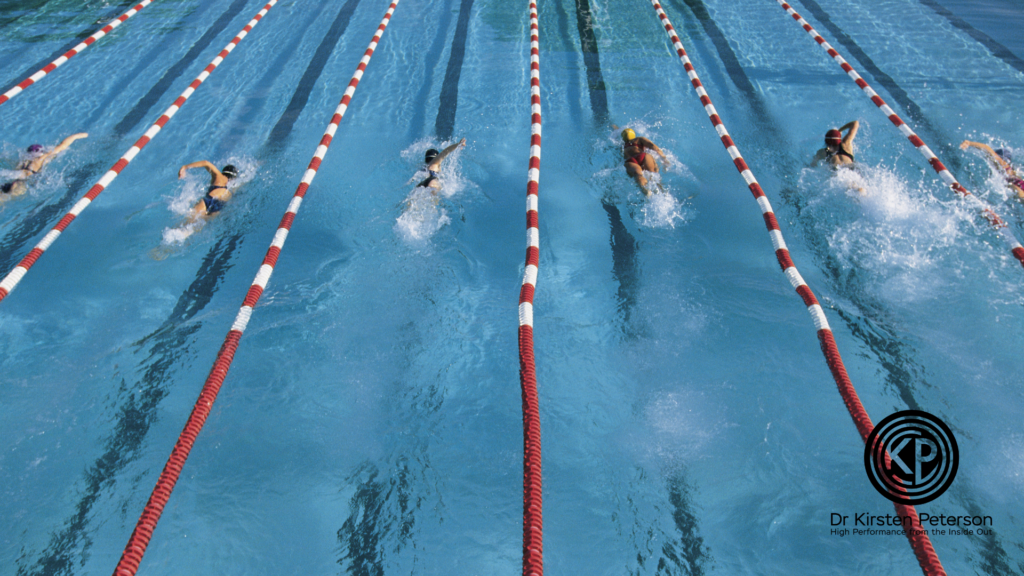
I was talking with one of the first athletes I had the opportunity to work with back in my early days as a sport psychologist. BJ was a talented swimmer grappling with performance anxiety issues coming into the 2000 Olympics, having narrowly missed out on qualifying for the 1996 team. 2000 was a different story, however; not only did BJ make the Olympic team, she won her long-desired (and deserved) gold medal as part of the women’s 4×100-meter medley relay.
We were sharing stories from those days, among them the incredible fact that, throughout all our work together, when I was having her close her eyes to visualise (and presumably normalise) her upcoming Olympic races, unbeknownst to me, all her imagined races ended with false starts. While she was too embarrassed to tell me at the time, amazingly, she used those mental “failures” as fuel for her physical training fire. [Young athletes out there, hot tip: don’t leave your sport psychologist in the dark when your imagery goes haywire!] Needless to say, I was shocked to learn it even 26 years later, and relieved that her unconventional strategy was so effective!
With a wry sigh, BJ went on to relate how, in the swimming world, her relay medal was seen as “less than” compared to those athletes who won their medals—all by themselves—via individual events. As if there wasn’t something equally compelling about winning as part of a great team. She didn’t even talk about her medal for years, relegating it to an interesting but not compelling part of her life story. But now, it’s front and centre on her LinkedIn page, and she has come to realise that a gold medal means something very different to the people she works with and leads. She finally took advantage of the leverage that this accomplishment gives her in the wide world outside of swimming.
BJ’s story prompted me to share my same-but-different story. As a sport psychologist working with the US Olympic Committee and the Australian Institute of Sport, I worked at seven Olympic Games. It was part of the job—an extraordinary and, at times, almost sacred part of it. When you go to the Olympics, even as staff, it becomes your Olympics too. But still, it wasn’t anything I’d felt like I’d earned–like going to the Games as an athlete–so when I left that world, I didn’t talk about it.

That only changed when my business mentor reacted with genuine shock that, after knowing me for five years, he’d only just discovered this fact. He treated it like I’d been hiding something significant. Then he made me say it out loud—“I’m a seven-time Olympic performance psychologist”—over and over again. At least 20 times. At first, I was hideously uncomfortable. Eventually, the repetition became funny. But underneath that discomfort was something more revealing: a real fear of sounding egotistical and self-centred.
What I hadn’t appreciated was that sharing this wasn’t about ego. It was about clarity. To the outside world, going to one Olympics might seem impressive (even if that’s not quite how it works), but going to seven signals something very different about experience and credibility. And there I was, effectively hiding that in plain sight. Now, like BJ, I’m okay with leveraging this career superpower, but only after I got over my own ickiness about it.
Having identified the problem, I see it everywhere. Interestingly, it’s more women than men in my experience: busy downplaying or otherwise ignoring or denying their own superpowers.

One such case in point. I once worked with a quiet, high-performing coaching client who simply refused to own her own capability. A partner in the firm told her that leaving her in charge of a project while he was too sick to work was one of the best decisions he’d made. Her reaction? She dismissed it outright—assuming he was just being polite.
And even when she allowed for the possibility that the feedback was genuine, she found other ways to explain it away. In her mind, the success had nothing to do with her. It was luck. A strong team. An easy client. A one-off set of circumstances that wouldn’t hold up anywhere else.
What struck me most wasn’t the self-doubt itself—it was how much effort she put into maintaining it. Forget leveraging for the good. It was all about maintaining something not only outdated, but truly unhelpful.
So when I say “superpower,” this could be something you earned and should celebrate (BJ’s gold medal), some hard-won expertise you can draw from (my experiences at the Games), or your own wonderful capabilities or talent (my coaching client).
So what’s a smart, high-performing woman to do?
If any part of these stories feels familiar, you’re not alone. But here’s the problem. When you downplay or hide your achievements, expertise, or strengths, it has consequences—for you, your work, and the people around you. You don’t get the opportunities you’re ready for. Others don’t get the benefit of what you bring. And organisations underperform because capability is sitting there…unused.
So, how do you stop leaving your superpower on the table?
1. Acknowledge what’s already there.
If this feels weird, that’s normal. Most people aren’t great at objectively assessing their own strengths. So go to someone you trust: What do I do that actually makes a difference? What would you say are my biggest strengths? Get specifics on what people say you do, don’t just collect compliments. And then—this is the important part—don’t argue with the answers. Let them in.
2. Pay attention to the stories you tell yourself about those strengths.
This is where many of us get stuck. The instinct is to minimise:
- I just got lucky.
- Anyone could have done that.
- It wasn’t that big a deal.
Instead, consider something different: What if that result actually said something real about me? This is not about arrogance. Rather, it’s moving from dismissal to curiosity.
3. Get comfortable with the discomfort.
That sense of self-promotional “ickiness” is more common than you might think. Too many of us worry about being seen as self-centred or stepping outside our lane.
But here’s what I have learned working with firms and leaders: quiet capability, on its own, is rarely enough. When people struggle fully appreciate–much less articulate–the value they bring, others are left to interpret it for them, and more often than not, they underestimate it. Opportunities are missed, potential is under-utilised, and impact is diluted.

When acknowledging your achievements, expertise, or strengths feels self-centred, it’s easy to retreat and stay small. But when you begin to see those same superpowers as something that enables better outcomes—for your clients, your colleagues, and the work itself—the equation changes. It becomes less about self-promotion and more about responsibility.
In that sense, this isn’t really about confidence or even modesty. It’s about effectiveness. And in environments where performance matters, holding back what you’re capable of isn’t neutral—it comes at a cost.
So don’t leave your superpowers on the table. And definitely don’t keep them hidden underneath!
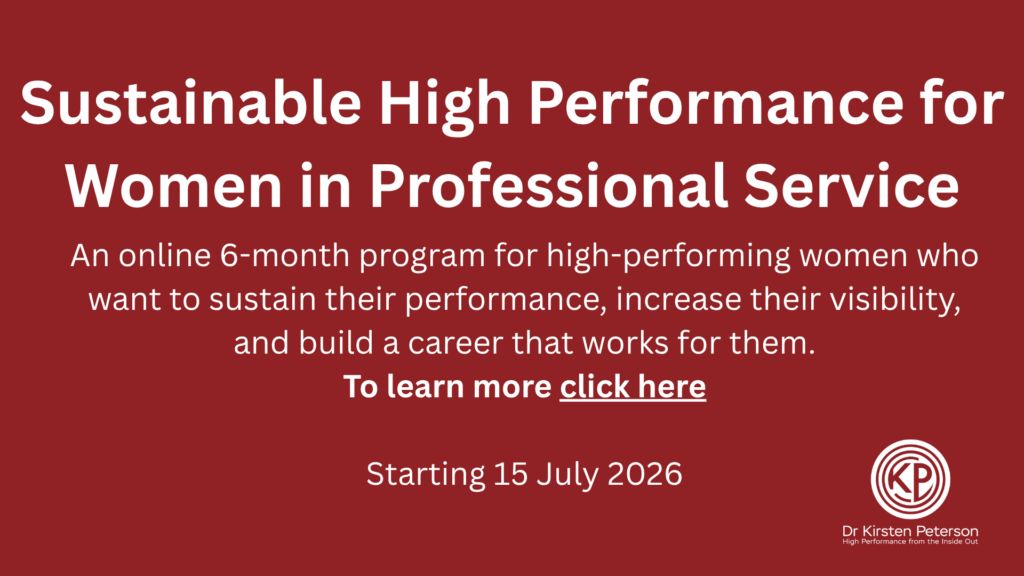
If this is something you want to tackle for yourself, or know someone who could use this help, I am psyched to let you know about a new online program just for high-achieving women – Sustainable High Performance for Women in Professional Services.
This is a 6-month online program commencing 15 July 2026 for high-performing women in professional services who want to sustain their performance, increase their visibility, and build a career that actually works for them.
Join me for 6 x 90-minute content modules and 6 x 60-minute group coaching sessions.
Investment: $1,500 + GST per person (early bird pricing available)